
Crawford County Criminal Docket Searches
Begin at the Kansas District Court Public Access Portal. Pick District Court first. Then search by Case Number, Party Name, Business Name, Party As Business Name, or Citation Number. Crawford results can sit under Crawford County, Crawford-Girard County, or Crawford-Pittsburg County, so a blank screen under one label does not rule out a public case.
Search smart. The strongest identifier wins. A case number beats a citation number, and a citation beats a guessed name. Records predating the Odyssey rollout may not match that numbering, and the FullCourt transition left some files looking different. A terminal at the courthouse can also reach public material the portal withholds.
- Select District Court and the matching search type.
- Enter the complete number or exact public name.
- Try the Crawford, Girard, or Pittsburg venue label.
- Narrow by Criminal or filing date only when needed.
- Compare the result with the local docket calendar.
- Ask the proper clerk for a defined copy.
Crawford Criminal Case Numbers
Case numbers tell you where a Crawford County charge was filed. Per the Crawford Judicial Center guidance, a number ending in P points to Pittsburg, and one ending in G points to Girard. The newer statewide format works differently. It strings together a venue abbreviation, the year, a two-letter case type, and a running sequence, such as RL-2019-CR-000001. Treat that as a format example only. It is not an actual Crawford case number.
Missing result: Search the number as printed, try the party or citation path, and check the alternate Crawford venue before calling the clerk.
When you contact the clerk, give the full identifier, the rough date, and any Girard or Pittsburg clue you have. The live portal may ask for human verification before it lets you search the docket.
Criminal Dockets: What They Show
When you ask the clerk for a docket search, hand over the full identifier, a rough date, and any Girard or Pittsburg clue you have. The live portal may still require human verification before it returns the record.
| Case number | Identifies the file, type, year, and sometimes venue. |
|---|---|
| Charge | States an accusation, not a finding of guilt. |
| Setting | Gives a planned date, time, hearing type, judge, division, and mode when published. |
| Motion | Shows a request was filed; it does not reveal the ruling alone. |
| Disposition | Records an outcome. The signed order controls. |
Keep the filing date, the event date, and the hearing date separate when you read a docket entry, and remember that a future setting can still move.
Crawford Settings Are Not Convictions
Girard docket entries carry labels like Preliminary Examination, Waiver/Plea, Probation-Violation, and Motion to Reinstate Bond. Each one names a stage or a topic. That is all it does. A preliminary examination in an eligible felony matter tests probable cause, while a probation-violation setting merely flags the type of hearing ahead and says nothing about whether a violation was ever proven.
Warrants and bond motions deserve the same care. When you need an official result, check the register for the disposition and ask the clerk for the signed order.
Note: A public calendar tells you what was scheduled. It does not tell you what happened in court or what the judge decided.
Criminal Case Stages on the Docket
Crawford County criminal cases rarely travel a single road. At the first appearance, the court handles initial procedure. It also gets the case on the record. A felony matter may then move to a preliminary examination. Arraignment comes next as the formal plea stage. Pretrial settings can cover motions, evidence, scheduling, diversion, or plea talks. From there the case can resolve by dismissal, diversion, plea, court trial, jury trial, or some other lawful ending.
Docket flow: Filing › First Appearance › Preliminary Examination › Arraignment › Pretrial › Plea or Trial › Disposition › Sentencing
Judgment does not always close the file. Restitution, probation, alleged violations, and motions can all surface later on the docket, so read each entry beside its date and the order that followed it.
Crawford Criminal Dispositions by Number
The Kansas Courts FY2025 table counts 221 Crawford County felony dispositions: 144 guilty pleas, 58 dismissals, 9 jury trials, 6 deferred or diversion results, and 4 other outcomes. Misdemeanors totaled 137 dispositions, with 50 guilty pleas, 39 other outcomes, 36 dismissals, and 10 deferred results.
These counts are dispositions, not arrests or open files, and they never identify a unique person. They simply show how the Crawford County criminal docket splits its workload by category.
Crawford County Criminal Docket Courts
Crawford County District Court belongs to the Eleventh Judicial District. Its criminal court records sit in two places. Those places are Girard and Pittsburg. The Girard courthouse listing covers felony and misdemeanor holdings from 1991 forward. It also includes some older material. At the Pittsburg Judicial Center, the criminal holdings include bad-check cases and related records.
Girard District Court
111 E Forest Street
Girard, KS 66743
620-724-6212
Pittsburg District Court
602 N Locust Street
Pittsburg, KS 66762
620-231-0380
Municipal ordinance cases stay with the city court that issued them, unless a lawful transfer or appeal moves them. Federal matters run through the federal courts, not this state system.
Crawford Criminal Terms in Plain Words
Calendar vocabulary describes procedure. It should not be used as a verdict.
- Charge
- An accusation filed as a count.
- Arraignment
- The formal notice and plea stage.
- Diversion
- A court-approved program with stated terms; the order controls.
- Disposition
- The recorded result of a count or case.
- Expungement
- Order-based treatment of a record, not the same as dismissal.
A payment record is not the same thing as a Crawford County criminal court docket, and neither is a criminal-history record. Only the court file itself tells the full story.
Access Rules for Criminal Dockets
Kansas Supreme Court Rule 22 sets the ground rules for looking at court records from home. It keeps certain matters off the screen. Juvenile files, expunged cases, sealed records, and protected family matters stay off the remote view. Rule 106B draws the line. It splits what you see in the register, what a courthouse terminal shows, and what counts as the official record.
Locally, Eleventh Judicial District Local Rule 13 lets you inspect files during clerk hours and invites a written request. Copies run 25 cents per page. Certification costs $1. Work needing a clerk's concentrated attention is billed at $12 per hour. Give the case number, the division, the date range, and the exact item you want. Mail works, and so does the Kansas Judicial Branch request form. A quick call can sort out where to send your docket request.
The statute itself is published by the Kansas Legislature expungement source. It appears in its official government text.
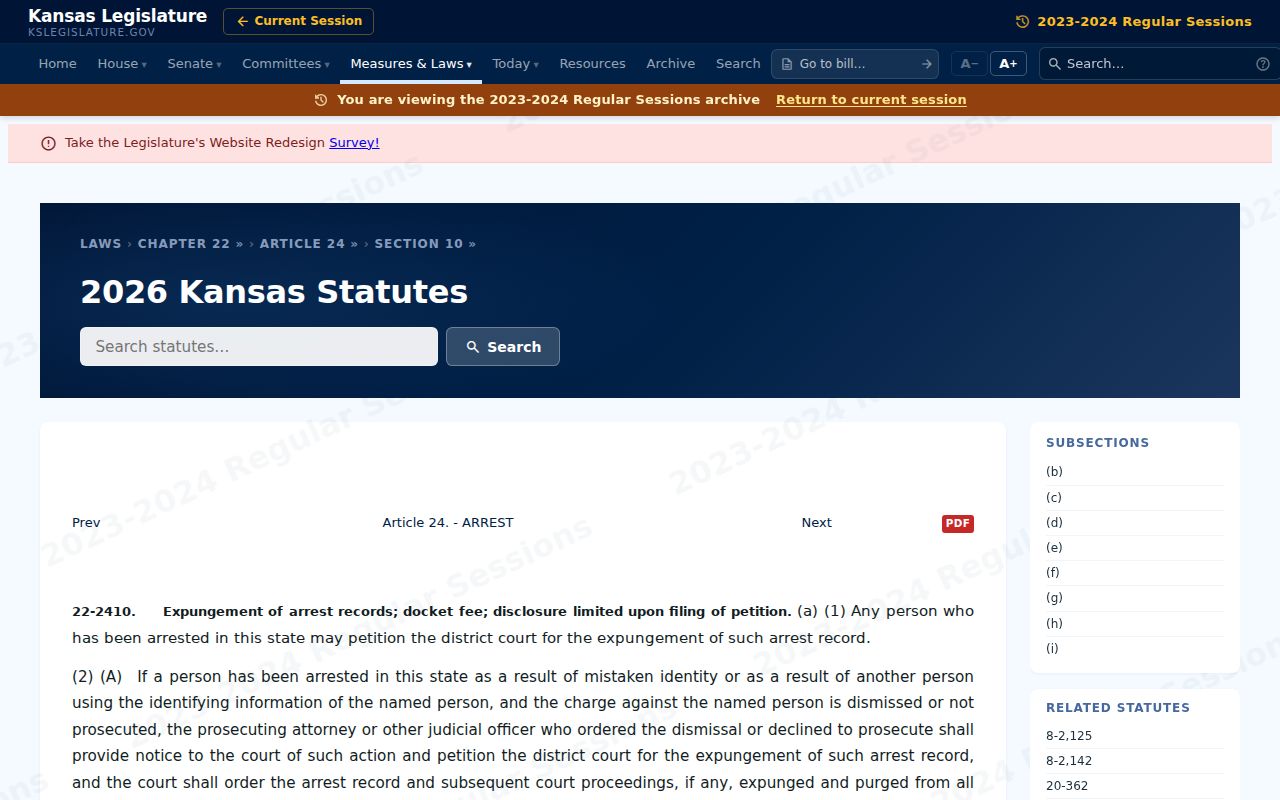
A court-ordered expungement process is its own thing, distinct on the record from a dismissal and from a portal search that simply comes up empty.
Expungement: K.S.A. 22-2410 addresses petitions and disclosure limits. An absent result may reflect lawful restriction.
Access comes in more than one form. A criminal docket in Crawford County might be viewed from afar, read at a court terminal, or issued as a redacted or certified copy. If the clerk turns you away, ask which rule blocks you and which office truly holds the court records.
Crawford Copies and Clerk Requests
Crawford County clerks can only fetch what you can point to. So make your request narrow and exact. Name the filing, order, or event you want from the public register, and give the case number, the Girard or Pittsburg division, and a date range. Want the outcome of a case? Ask for the disposition or sentencing order. Want a court date ahead? Ask for the public hearing calendar or docket setting. Those two requests pull different records.
Call the district clerk first. Confirm which division holds the file and whether a written request is required. Depending on the office, you may get counter inspection, courthouse-terminal access, ordinary copies, or certification. A mailed request should carry your contact information. It should give enough detail for staff to estimate the cost. The clerk need not answer an open-ended question. The clerk also need not explain what a docket entry means. That interpretation is yours to make.
Older criminal records take extra patience. Girard and Pittsburg keep separate holdings, and a case may predate the current system. State the year, and note any P or G suffix on the case number. When a portal event shows but its attachment will not open, ask whether the document can be viewed at a public terminal or supplied directly. If something is restricted, request the rule, statute, or order that controls access. Ask whether a public part can be split out.
Certification only proves the clerk supplied an official copy. It reads nothing into the case, and no single event makes a full history. Keep the copy with its case number and date so the context stays clear.